Poor method selection on a concrete drilling or sawing operation can cost a project tens of thousands of pounds in rework, delays, and regulatory penalties. For project managers and contractors handling industrial concrete work across the UK, the margin for error is slim. Choosing the wrong bit, blade, or technique on a reinforced slab or structural wall can compromise structural integrity, breach environmental regulations, and put workers at risk. This article sets out a clear, criteria-driven framework for selecting and executing the right drilling and sawing methods, covering decision criteria, best practices, safety pitfalls, and a direct method comparison.
Table of Contents
Key Takeaways
| Point |
Details |
| Choose the right method |
Use project criteria like material, site, and deadline to determine the most suitable drilling or sawing technique. |
| Safety first |
Prioritise risk assessments and environmental controls to prevent injuries and meet compliance. |
| Adapt on site |
Stay flexible and prepared to adjust your approach based on site surprises for best results. |
| Specialist tools matter |
Select diamond, wire, or hydraulic methods according to structure and project needs for clean results. |
Establishing the right criteria for drilling and sawing
Every successful drilling or sawing operation starts with a thorough assessment of the project parameters. Rushing this stage is where most costly mistakes begin. Before any equipment is mobilised, you need to evaluate the following criteria in order:
- Material type and reinforcement — Identify whether the concrete is plain, reinforced, or post-tensioned. The presence of rebar or tendons dictates which methods are viable.
- Site safety requirements — Assess access restrictions, proximity to live services, and any structural sensitivity that limits vibration or load.
- Noise, vibration, and dust limits — Many UK sites operate under local authority noise restrictions or have occupant-sensitive environments nearby. These constraints directly affect method choice.
- Project timeline — Some methods are faster but louder or more disruptive. Others are slower but safer for sensitive structures.
- Access and space — Confined spaces may rule out large floor saws or wall-mounted rigs entirely.
Reviewing these criteria against industry standards for drilling and sawing before committing to a method will prevent costly late-stage changes.
Important: Edge cases require specific approaches such as stitch drilling for large openings and avoiding hydrodemolition near post-tensioned tendons. Applying a standard method to a non-standard situation is a common and avoidable error.
Pro Tip: Always review structural drawings for hidden services, post-tensioned tendons, or pre-stressed elements before selecting your technique. Discovering these mid-operation causes significant delays and safety risks.
Essential tips for concrete drilling
With the decision framework in place, the focus shifts to executing drilling operations correctly on site. Even experienced teams can introduce errors through small oversights.
Core drilling best practices include:
- Select the correct equipment — Match the drill rig to the diameter and depth required. Underpowered equipment causes bit wear and inaccurate holes.
- Maintain a consistent water supply — Water cools the diamond bit and suppresses dust. Interruptions cause overheating and premature bit failure.
- Secure the work area — Ensure the drill rig is anchored firmly. Movement during drilling causes deviation and can damage reinforcement.
- Use pilot accuracy — Mark and check alignment before drilling. A misaligned core can compromise structural members or miss service routes entirely.
- Inspect and maintain tooling — Check diamond segments before each use. Worn segments reduce cutting speed and increase the risk of bit binding.
Diamond core drilling offers precise, dust-minimised holes that are vital for reinforced concrete, making it the preferred choice for structural penetrations. For softer or lightly reinforced concrete, tungsten carbide bits are a cost-effective alternative, but they are unsuitable for heavily reinforced sections where diamond tooling is essential.
Slurry management is a legal requirement, not an optional step. Water mixed with concrete dust must be collected and disposed of in line with UK environmental regulations. Allowing slurry to enter drains is an offence under the Environmental Protection Act 1990. Review concrete drilling best practices and ensure your site has adequate containment before work begins.
For large-diameter cores, consider reliable drilling techniques that account for the increased torque and cooling requirements involved.
Pro Tip: Periodically withdraw the drill during deep cores to clear debris from the kerf. This reduces overheating, prevents bit binding, and extends tool life significantly.
Sawing strategies for reinforced concrete and demolition
Reinforced concrete and large-scale demolition sawing present distinct challenges compared to standard cutting. The following strategies apply across most industrial scenarios:
- Choose the correct blade type — Diamond blades vary by bond hardness and segment design. Soft-bond blades suit hard concrete; hard-bond blades suit softer mixes. Matching blade to material prevents rapid wear.
- Set depth guides accurately — Cutting deeper than required risks hitting tendons, services, or weakening adjacent sections. Set guides to the confirmed structural depth.
- Segment large cuts — For thick or heavily reinforced sections, break the work into sequential passes rather than attempting full depth in one pass.
- Control dust at source — Use wet-cutting methods or integrated dust extraction. Silica dust from concrete is a serious health hazard under COSHH regulations.
- Inspect post-cut integrity — After every significant cut, check the surrounding structure for cracking, movement, or unexpected load transfer before proceeding.
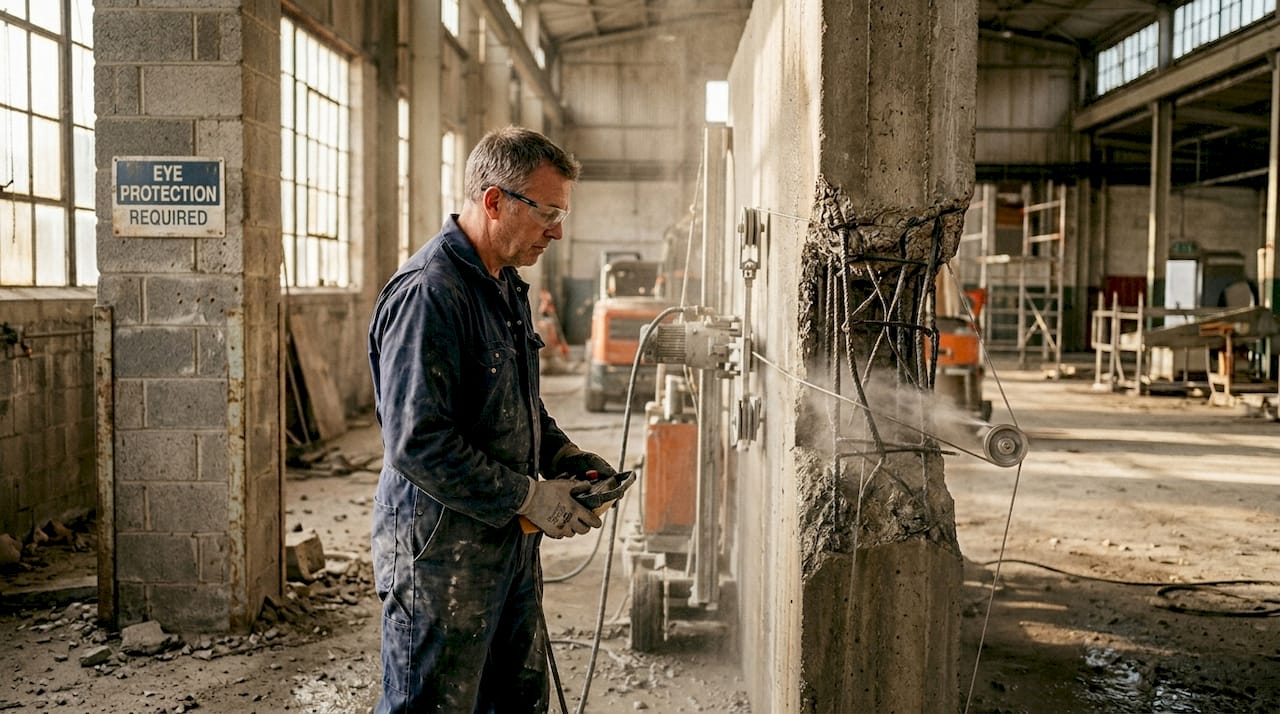
Wire sawing is recommended for thick, heavily reinforced sections where conventional blades cannot reach, while stitch drilling suits large openings. Understanding the wire sawing advantages over other methods is important for demolition planning.
| Method |
Material thickness |
Speed |
Noise level |
Relative cost |
| Floor sawing |
Up to 600 mm |
High |
High |
Low to medium |
| Wall sawing |
Up to 900 mm |
Medium |
Medium |
Medium |
| Wire sawing |
Unlimited |
Low to medium |
Low |
High |
| Hydrodemolition |
Variable |
Medium |
Medium |
High |
For noise-sensitive environments, track wall sawing offers a controlled, lower-noise alternative to handheld methods.
Note: Hydraulic bursting is a low-noise, low-vibration alternative for confined demolition work where sawing is impractical. It is particularly effective in occupied buildings or sites with strict noise limits.
Avoiding common pitfalls: Safety and environment
Technical competence alone is insufficient. Overlooking safety and environmental responsibilities creates liability, regulatory risk, and potential harm to workers and the public.
The most frequent mistakes on UK drilling and sawing sites include:
- Inadequate risk assessment — Failing to identify hidden services, structural weaknesses, or proximity to occupied areas before starting work.
- Poor dust and slurry control — Not using wet-cutting methods or failing to contain and remove slurry correctly.
- Improper PPE — Workers operating without respiratory protection, eye protection, or anti-vibration gloves when required.
- Ignored post-cut checks — Proceeding to the next operation without verifying the structural condition of the cut area.
- Vibration exposure — Prolonged use of handheld equipment without monitoring Hand Arm Vibration Syndrome (HAVS) exposure levels.
Understanding electric floor sawing risks is particularly important on sites with wet conditions or proximity to live electrical services.
Water run-off from wet cutting must be managed with bunded collection systems or wet vacuums. Vibration from floor sawing can also transmit through slabs to sensitive equipment or occupied floors below. Always assess this transmission path before committing to a method.
Critically, hydrodemolition should be avoided near post-tensioned tendons and water-sensitive areas, as high-pressure water can cause catastrophic structural failure or water ingress into sensitive zones. Reviewing site safety measures relevant to your project type will help establish the correct controls from the outset.
Expert comparison: Selecting the best method for your project
Bringing all criteria and techniques together, the following scenarios illustrate how to match method to situation:
- Low-noise requirement in an occupied building — Hydraulic bursting or wire sawing. Both generate minimal noise and vibration compared to saw-based methods.
- Speed-critical floor penetration — Floor sawing with a high-horsepower rig. Fastest method for horizontal cuts in open areas.
- Confined space with limited access — Stitch drilling or handheld wall sawing. Both can operate in restricted environments where large rigs cannot be positioned.
- Thick, heavily reinforced wall removal — Wire sawing. No blade size limitation and capable of cutting through any reinforcement density.
- Large opening in a load-bearing wall — Stitch drilling, hydraulic bursting, and wire sawing each have roles based on opening size and disruption limits.
| Situation |
Recommended method |
Key reason |
| Occupied building, low noise |
Hydraulic bursting |
Minimal vibration and noise |
| Speed-critical floor cut |
Floor sawing |
High output rate |
| Confined or restricted access |
Stitch drilling |
Compact equipment |
| Heavily reinforced thick wall |
Wire sawing |
No depth limitation |
| Large structural opening |
Stitch drilling or wire sawing |
Controlled, precise removal |
For projects requiring diamond wire sawing options, the method delivers the most versatile solution for complex demolition geometries.
A fresh perspective: Why flexibility beats rigid plans in drilling and sawing
No work method statement survives first contact with the actual site. Experienced contractors know this. Hidden tendons, unexpected reinforcement layouts, service conflicts, and ground conditions routinely invalidate the original plan within the first hours of work.
The contractors who deliver on time and within budget are not those with the most detailed upfront plan. They are the ones who build genuine flexibility into their method statements from the start. This means identifying two or three viable techniques for each critical operation and pre-agreeing with the client the conditions under which each would be activated.
Major UK infrastructure projects have demonstrated this repeatedly. Adaptability prevented significant delays when original methods proved unsuitable on site. Flexible drilling leadership is not about being unprepared. It is about being prepared for more than one outcome.
Pro Tip: Build a contingency method into every work method statement. Specify the trigger conditions clearly so the site team can switch without waiting for management approval.
How National Drilling Services supports your projects
Applying these tips consistently requires both the right knowledge and the right specialist partner.

National Drilling Services has delivered precise, safe concrete cutting and demolition across the UK since 1986. Whether your project requires diamond core drilling solutions to recover lost programme time, advanced wire sawing for demolition on heavily reinforced structures, or robotic demolition experts to clear confined or hazardous areas safely, the team brings the technical depth and equipment range to match. Contact National Drilling Services to discuss your next project and identify the most effective approach for your specific site conditions.
Frequently asked questions
What method should I use for large openings in reinforced concrete?
Stitch drilling is the technique of choice for large and reinforced openings, providing controlled removal with minimal structural impact to the surrounding concrete.
When is hydrodemolition unsuitable for concrete cutting?
Hydrodemolition is not recommended close to post-tensioned tendons or water-sensitive zones, as high-pressure water can cause structural failure or water ingress.
How can I minimise dust and slurry during sawing?
Use wet-cutting methods with a consistent water supply, fit dust extraction units where applicable, and collect slurry immediately for compliant disposal under UK environmental regulations.
What is the quietest method for concrete demolition?
Hydraulic bursting is a low-noise demolition option that generates minimal noise and vibration, making it suitable for occupied buildings and noise-restricted sites.
Recommended
Article generated by BabyLoveGrowth
